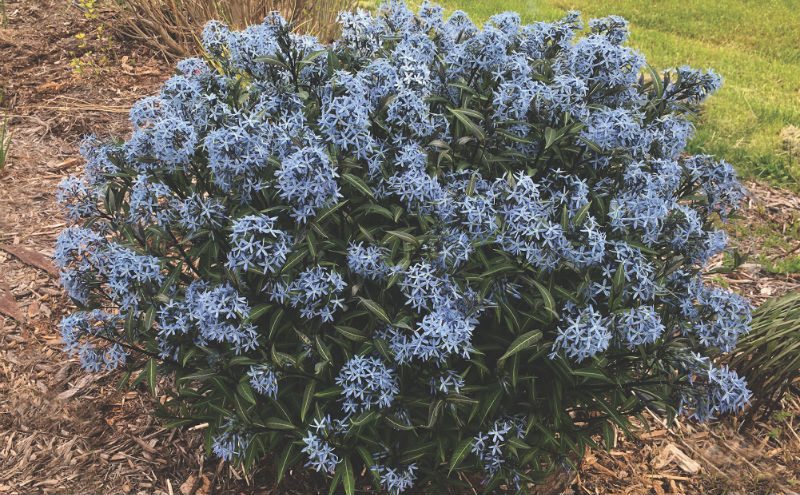
Amsonia, commonly called blue star, is a classic native perennial, low maintenance plant—with several notable species. Amsonia hubrichtii, native to Oklahoma and Arkansas, is best known for its brilliant gold fall color and deceptively soft, needle-like foliage. Amsonia tabernaemontana has the widest native range, extending from Florida in the south to New York in the north. ‘Storm Cloud’ Amsonia tabernaemontana was discovered growing in the wild in Alabama, making it a pure native, hardy perennial. It was named for its intensely dark shoots which pop out of the ground early each spring. By the time this bushy shrub-like perennial has fully emerged in late spring to early summer, periwinkle blue, star-shaped flowers cover its silver-veined, dark green leaves. 'Storm Cloud' is hardy in zones 4-9 and should be grown in full sun to part shade. It matures to 24-30" tall and is typically a deer resistant perennial. | |
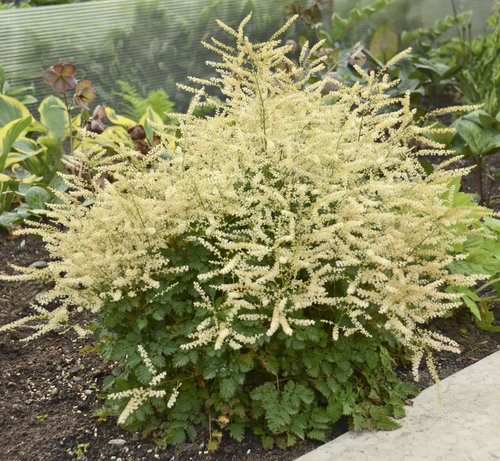
Aruncus, commonly known as goat's beard, has an extensive native range in North America. Our northern friends in Canada will see some in the wild, and its natural occurrence continues all the way down to the Southeast U.S. Some might mistake a similar perennial named Astilbe for goat's beard, but Astilbe is not native and can be more sensitive to drier soils. Goat's beard is a great native substitute. Goat's beard has similar wispy flower panicles as Astilbe, but it typically flowers a few weeks earlier in late spring to early summer. It performs well in shade gardens where it can tolerate average to somewhat dry soils, but it can also grow in full sun if adequate moisture is provided. ‘Chantilly Lace’ is a native cultivar of Aruncus, meaning its parent plants are derived from native species. It is a mid-sized selection, growing taller than the dwarf Aruncus aethusifolius but remaining more compact than the full-sized Aruncus dioicus. Hardy in zones 3–7, it performs well in both sun and shade. Plants mature at 30–32 inches tall and are typically deer-resistant perennials. | |
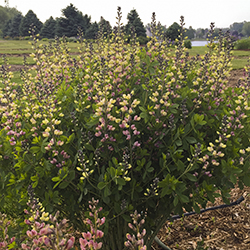
Baptisia australis, commonly known as false indigo, is one of the oldest known hardy perennials and was the first subsidized agricultural crop in America. It is exceptionally long-lived, often thriving in the landscape for 50 years or more. Several native species of Baptisia are found throughout the eastern United States and across the Great Plains, most commonly bearing blue, white, or yellow flowers. While many native Baptisia species grow quite large, we have refined them to better suit modern gardens. Decadence® varieties mature to a compact 2½ to 3 feet tall—similar in size to a clump of daylilies—while Decadence® Deluxe varieties grow slightly taller, reaching 3½ to 4 feet. These series offer eight distinct flower colors, significantly expanding the traditional native color range. The new Decadence® Deluxe 'Pink Lemonade', shown here, features striking bicolor blooms of yellow and raspberry purple in late spring to early summer. Like all plants in the series, decorative seed pods replace the flowers and extend seasonal interest into winter. Decadence® Baptisia are hardy in zones 4–9, perform best in full sun to light shade, are typically deer resistant perennials, and are attractive to butterflies. | |
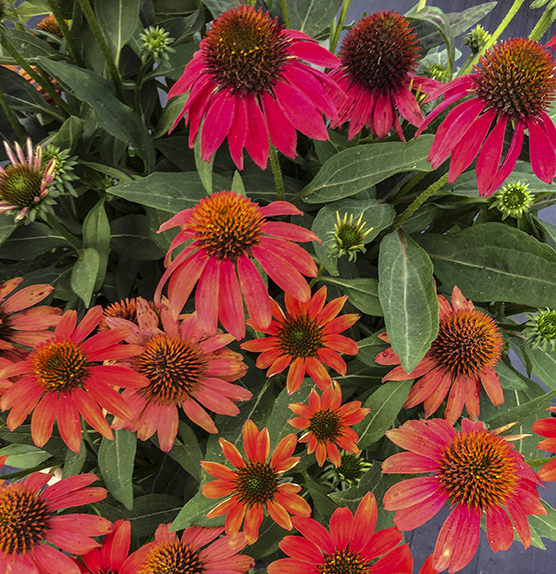
The genus Echinacea, commonly known as coneflower, includes several species native to the United States. Many cultivars available today include Echinacea purpurea in their parentage, a species commonly found throughout the eastern half of the U.S., from Michigan to Florida. Echinacea pallida is another widespread species, occurring from Ontario, Canada, south to Texas. The yellow-flowering Echinacea paradoxa has a more limited native range, extending from the Great Plains states into Texas. Most modern Echinacea hybrids are complex crosses of multiple native species, with breeders selecting for unique flower colors, well-branched growth habits, and strong, upright stems. Summersong™ Firefinch is a complex hybrid Echinacea featuring fragrant, 3½-inch flowers in rich shades ranging from red-orange to pink-red. It blooms nearly all season, from early summer into early fall, and performs well in zones 4–8 in full sun to part shade. With a compact height of just 12–16 inches, this petite variety is ideal for containers or for planting near the front of the flower border in a native perennial garden. | |
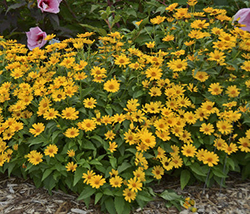
With the exception of the warmest western states, Heliopsis helianthoides can be found growing wild along roadsides, in open woods, and in fields across much of the United States and Canada. It tolerates average to somewhat dry soils and does not require rich soil to perform well. This species also makes an excellent substitute for Rudbeckia ‘Goldsturm’ in areas where black spot disease (Septoria) is a concern. We offer two varieties of Heliopsis to brighten gardens in full sun to light shade from midsummer through fall. Tuscan Gold™ features slightly larger, deeper yellow flowers on plants reaching 24–32 inches tall and is hardy in zones 4–9. 'Tuscan Sun' (shown here) blooms prolifically with golden yellow flowers on a more compact 20–24-inch plant and offers increased hardiness in zones 3–9. Pollinating bees and butterflies are drawn to the cheerful blooms of these low maintenance plants. | |
Heuchera, commonly known as coral bells, are extremely versatile, colorful native perennials that thrive in landscapes and in containers. Many native species can be found in different climates around the U.S. including Heuchera americana (Eastern U.S.), Heuchera micrantha (Western U.S.), Heuchera sanguinea (New Mexico, Arizona, Pennsylvania), and Heuchera villosa (Southeastern U.S.), and a few other more obscure species. Most varieties you see at garden centers are a result of crossing many different species, all of which are native to the U.S. The resulting plants have a wide range of foliage colors, leaf shapes and sizes, and flower colors. Heuchera villosa cultivars tend to be naturally heat and humidity tolerant because the summers in their native habitat are hot and sticky. They also tend to have larger, fuzzier leaves and greater vigor. An example of a H. villosa cultivar is Primo™ 'Black Pearl', which has large, jet black leaves and a vigorous growth habit. Selections of coral bells that have intense pink and red flowers tend to come from the species Heuchera sanguinea. An example of a H. sanguinea cultivar is Dolce® 'Appletini' (shown here) which bears fire engine red flowers and chartreuse foliage. Dolce® and Primo™ coral bells will grow in sun and shade, though their best coloration usually is achieved in part sun. Varieties with lighter colored foliage typically require more shade than those with dark leaves. Plant them in fertile, well-drained soil and provide average moisture levels. Mulching the plants in fall will help to prevent heaving from freeze/thaw cycles in northern climates. Heuchera is hardy in zones 4-9 and a beautiful option for a native perennial garden. | |
Most varieties of perennial hibiscus, also known as rose mallow, sold today trace their lineage primarily to Hibiscus moscheutos, a species native to the eastern United States with a range that extends into parts of the Southwest. Some cultivars also include genetics from other native species, such as Hibiscus coccineus. In their natural habitat, these plants grow along the edges of bodies of water, where their roots remain consistently moist. In the wild, many perennial hibiscus can reach heights of more than six feet. Modern perennial hibiscus selections have refined these plants to a more garden-worthy size while increasing fullness and flower production. Proven Winners hibiscus are selected for their compact habit, larger and higher-quality blooms, and indeterminate flowering—meaning buds form along many nodes of the stems rather than only at the tips. This results in a more attractive plant that flowers more heavily and over a longer period in the garden. Summerific® ‘Perfect Storm’ (shown here) stands just 3' tall and 4 1/2 to 5' wide. A backdrop of dark foliage sets the stage for its dinner plate-sized, pink and white bicolor blooms from midsummer into early fall. All Summerific® perennial hibiscus varieties are hardy in zones 4-9 and grow best in full sun to light shade. Because of their large size and extensive root system, these hardy perennials grow best in the ground rather than in containers where they require consistent moisture to thrive. They are typically deer resistant perennials, but bees and hummingbirds enjoy their blossoms. | |
The Pardon My series is derived from a native species and blooms reliably each year from mid to late summer on compact plants reaching 10–18 inches tall. Bee balm is an excellent perennial choice for attracting pollinators to a native perennial garden, as bees, butterflies, and hummingbirds are drawn to the sweet nectar in its tubular-shaped florets. Hardy in zones 4–8, it grows well in full sun to part shade and prefers average to consistently moist soil. Due to its mint-scented foliage, these are typically deer resistant perennials. | |
Panicum virgatum, commonly known as switchgrass, is a low maintenance native ornamental grass found throughout much of the North American prairie and across most of the United States, excluding the far western states. It is an extremely versatile and easy-to-grow plant that adapts to nearly any soil type and moisture level, from wet conditions to dry. Its primary requirement is full sun, with a minimum of six hours of direct sunlight per day. Most varieties mature at heights ranging from 3 to 6 feet. Each of the selections in our Prairie Winds® Panicum collection is unique. 'Apache Rose' (shown here) forms a dense, upright, 4' tall column of grey-green leaves that are topped with a profusion of burgundy seed panicles in late summer. 'Cheyenne Sky' is useful for adding color to the garden beginning in early summer when its 3' tall foliage starts its transition from green to wine red. 'Totem Pole' is a 6' tall selection that forms a narrow column of steel blue foliage. Prairie Winds switch grass is hardy in zones 4-9 and is typically deer resistant perennials. When left standing, its foliage provides winter interest and offers valuable shelter for birds and other wildlife. | |
Penstemon, commonly known as beardtongue, is a very large genus with a lot of genetic diversity. You'll find varieties with tubular-shaped flowers in every color of the rainbow on both short and tall plants. Their hardiness varies greatly, so always read the label to check the hardiness before you buy. Some species are native to the North American prairie, while others like Penstemon digitalis are typically found in the Eastern U.S. Other species are native to Mexico and are grown as annuals in much of the U.S. Decades ago, the perennial beardtongue variety ‘Husker Red’ was developed at the University of Nebraska. It was one of the first selections to feature purple-tinged foliage and produced abundant white flowers on tall stems. More than 30 years later, we introduced 'Midnight Masquerade', a bold improvement that forms a sturdy clump of deep burgundy foliage reaching 36–40 inches tall and is topped with a profusion of lavender-purple flowers beginning in midsummer. This variety is highly attractive to pollinators. ‘Midnight Masquerade’ beardtongue is hardy in zones 3–8, requires full sun, and is very heat- and drought-tolerant once established. | |
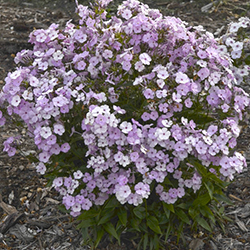
Phlox is a very common wildflower you'll see blooming anytime from late spring through the summer months across the Great Plains states, along the East Coast, and all the way south to Florida. Though most bear pastel pink, purple, or white flowers, the size of the plants and their habit range quite a bit from tall, upright plants to those that spread low and wide. Most species need full sun to thrive. You might be familiar with tall garden phlox (P. paniculata) or creeping phlox (P. subulata); there are many other native species too. Hybrid phlox is relatively new in the gardening world. Hybridizers have learned to select the best traits from the many native species of Phlox to develop new varieties that are more disease resistant, have stronger stems, a longer bloom time, and other desirable traits. Opening Act Phlox varieties are upright plants that bloom earlier in the season than traditional tall garden phlox, typically beginning in early summer. Their glossy foliage is highly disease resistant, and their fragrant flowers rebloom sporadically into early fall. 'Opening Act Blush' shown here, is a standout selection. 'Cloudburst' Phlox features a dome-shaped habit similar to cushion phlox, with rich purple flowers that form a billowy cloud above glossy, disease-resistant foliage throughout the summer. Butterflies and hummingbirds love Opening Act and 'Cloudburst' Phlox. They are hardy in zones 4-8 and grow best in full sun. | |
Schizachyrium scoparium, commonly known as little bluestem, is one of the most prolific native ornamental grasses grown today. It occurs naturally in 46 of the 48 contiguous United States, with Oregon and Nevada as the primary exceptions, and can also be found coast to coast across Canada. Because it spreads by seed, little bluestem often appears in sunny areas and can vary widely in height and fall color. It typically establishes in sandy to clay-loam soils, where its deep root system contributes to moderate drought tolerance. One of the main challenges of this grass for home gardeners is a natural trait that helps the plant disperse its seed. As seeds mature in fall, the stems bend and fall to the ground, placing the seed directly onto the soil. While this is beneficial for natural reseeding, gardeners typically dislike the floppy appearance. As a result, hybridizers have spent decades working to breed this trait out of cultivated selections. Prairie Winds® 'Blue Paradise' maintains a strong, upright habit throughout the season—even in wind and rain—making it a standout in the fall landscape. Its cool, silvery blue foliage deepens to rich wine-purple tones as temperatures cool. Hardy in zones 3–9, it grows 3 to 3½ feet tall and performs best in full sun. | |
Tiarella cordifolia, commonly known as heartleaf foamflower, is a beautiful native wildflower that can be found growing in the wild from Ontario to Georgia, throughout the Upper Midwest and down the East Coast. It is currently listed as an endangered wildflower in New Jersey and Wisconsin. In its native habitat, Tiarella grows in shaded, cool, deciduous woods and along stream banks in rich, well-drained, moist soil. While the species spreads as a groundcover by underground runners, many selected cultivars are clump-forming, meaning they remain neatly in place where planted. One example is 'Cutting Edge' foamflower, a Proven Winners introduction. It is named for its attractively serrated green foliage, each leaf marked with a dark burgundy blotch at the center. Plants form a tidy, rounded mound topped with creamy white, bottlebrush-like flowers in early spring, making it one of the first perennials to bloom in the garden. Grow foamflowers in part shade to full shade in zones 4-9. They make an excellent underplanting for taller hardy perennials and shrubs, and are an excellent cover for dying bulb foliage in late spring. The foliage of 'Cutting Edge' grows 8-10" tall and its flowers top out at 14".
This diverse collection showcases the beauty and resilience of Proven Winners native perennials.
| |






 Tuscan Heliopsis helianthoides (False Sunflower)
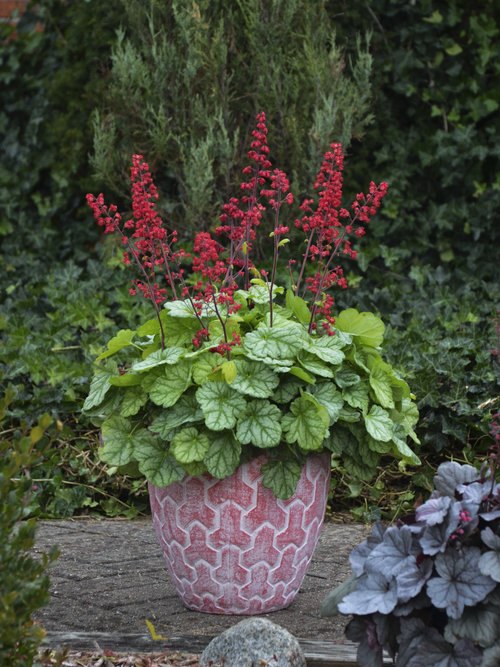 Dolce®
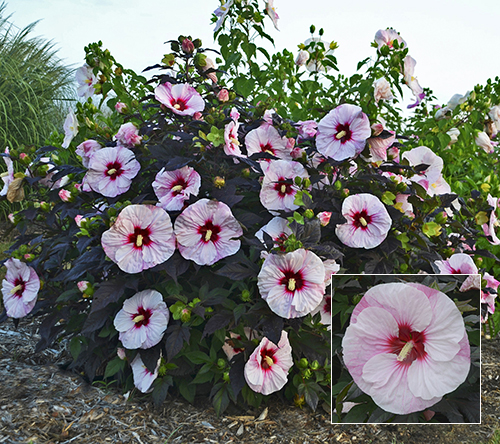 Summerific® Hibiscus (Rose Mallow)
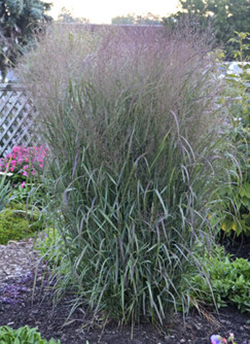 Prairie Winds® Panicum virgatum (Switch Grass)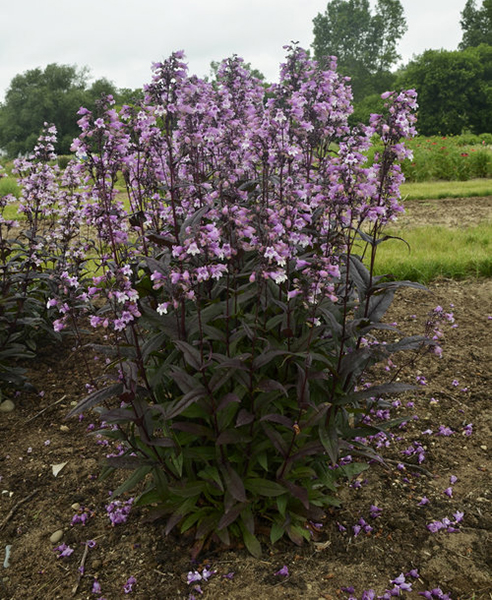
 Prairie Winds® 'Blue Paradise' Schizachyrium scoparium (Little Bluestem)
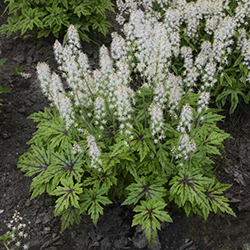 'Cutting Edge' Tiarella (Foamflower)